

Electric vehicles run on more than one kind of battery and the chemistry inside your EV quietly shapes everything from range and charging speed to safety and how long the pack lasts. Whether you’re comparing your first EV purchase or just curious what’s under the floor of your electric scooter or car, here’s a clear breakdown of every major battery type in use today.
How EV Batteries Work
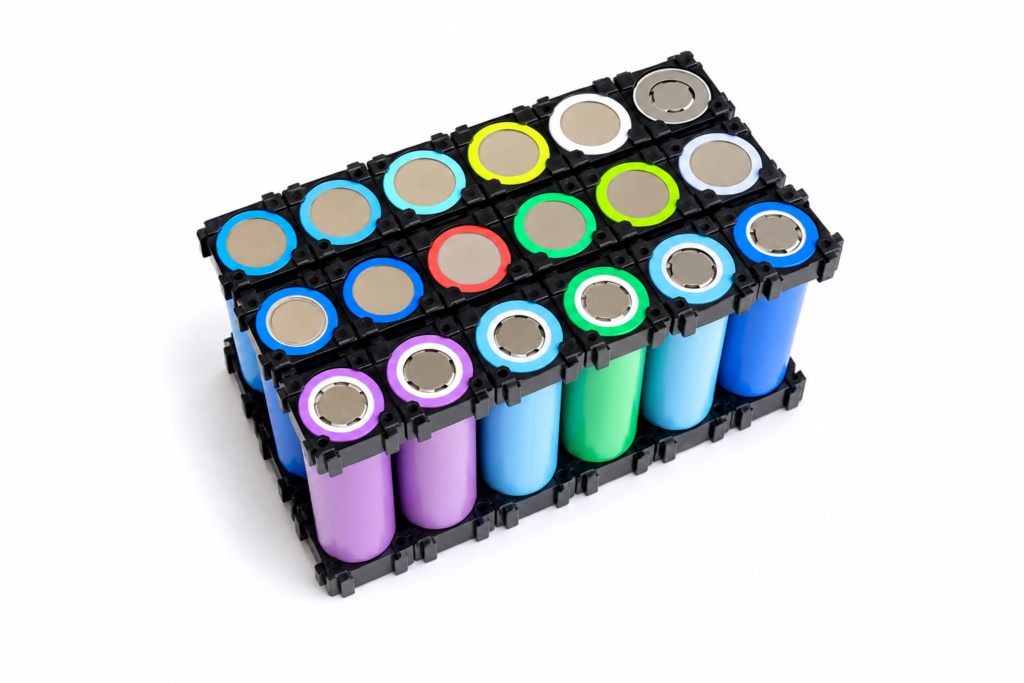
An Ev Battery pack is a combination of Multiple Small battery packs. Very commonly 3.6v18650 Li-ion Batteries are used to create a Stack of Series & parallel Pairs. Batteries stacked in Series for Increasing Voltage while Parallel for Increasing capacity. An Electronic device known as BMS (Battery management system) or Battery protection system is added To protect it from Overcharging and Battery Drain management.

1. Lithium-Ion (Li-ion) The Industry Standard
Lithium-ion is the umbrella category for nearly every modern EV battery, prized for high energy density (more range per kg) and a long usable life.
Pros: High energy density, lightweight, fast charging, low self-discharge
Cons: More expensive raw materials, requires careful thermal management
Used in: The vast majority of electric cars, scooters and commercial EVs today
2. Lithium Iron Phosphate (LFP)
LFP has become one of the most popular sub-types of lithium-ion for mass-market EVs, thanks to its safety profile.
Pros: Excellent thermal stability, long cycle life, doesn’t use cobalt, safer under stress
Cons: Lower energy density than NMC/NCA, meaning shorter range for the same battery size/weight
Used in: Budget-friendly EVs, fleet vehicles, public transport
3. Nickel Manganese Cobalt (NMC)
NMC batteries balance range, power and cost, making them a favorite among manufacturers targeting longer-range vehicles.
Pros: Higher energy density than LFP, strong performance, versatile
Cons: Contains cobalt (costlier, more supply-chain scrutiny), less thermally stable than LFP
Used in: Many mainstream long-range electric cars
4. Nickel Cobalt Aluminum Oxide (NCA)
NCA sits in similar territory to NMC favored for high-performance applications.
Pros: High energy density, strong discharge rates, long range
Cons: Costlier, more complex thermal management needed
Used in: Premium and performance-oriented EVs
5. Nickel-Metal Hydride (NiMH)
An older technology, now mostly a hybrid-vehicle story rather than a full-EV one.
Pros: Safe, reliable, well-proven over decades
Cons: Heavier, lower energy density than lithium-based options
Used in: Early hybrid vehicles (e.g. early Toyota Prius models); rare in pure EVs today
6. Lead-Acid
The oldest rechargeable battery technology still in limited EV use.
Pros: Inexpensive, simple, easy to recycle
Cons: Heavy, low energy density, short lifespan compared to lithium options
Used in: Low-cost or low-performance EVs, some two- and three-wheelers and often still for a vehicle’s separate 12V system
7. Lithium Titanate (LTO)
A niche but interesting chemistry built for speed and longevity rather than range.
Pros: Very fast charging, exceptionally long cycle life
Cons: Lower energy density, so shorter range per size
Used in: Select models like Honda’s Fit EV and some Japan-market Mitsubishi i-MiEV variants
8. Emerging: Solid-State Batteries
Often called the “next generation” of EV batteries, solid-state technology replaces the liquid electrolyte with a solid material.
Pros: Potentially double the energy density of current lithium-ion, faster charging, improved safety
Cons: Still largely in development, not yet widely commercially available
Watch for: Expected to gradually enter production vehicles over the next few years
9. Emerging: Sodium-Ion
A lithium-free alternative gaining research attention as a lower-cost option.
Pros: Doesn’t rely on lithium or cobalt, potentially cheaper to produce
Cons: Currently lower energy density, still maturing as a technology
Watch for: Positioned as a complement to lithium-ion for cost-sensitive applications, not yet a full replacement
Battery Cell Formats: Cylindrical, Prismatic, Pouch
Beyond chemistry, EV batteries also differ in physical cell format:
Cylindrical cells (e.g., the 18650 or 21700 formats) compact, well-suited to heat management between cells, used by Tesla and others
Prismatic cells rectangular, space-efficient packing into hard casings
Pouch cells flexible foil-sealed cells that are lightweight but need external structural support
Quick Comparison Table
| Battery Type | Energy Density | Cost | Safety | Typical Use |
| LFP | Medium | Lower | High | Budget EVs, fleets |
| NMC | High | Medium-High | Medium | Long-range EVs |
| NCA | High | High | Medium | Premium/performance EVs |
| NiMH | Low | Medium | High | Hybrids |
| Lead-Acid | Very Low | Very Low | High | Low-cost/low-speed EVs |
| LTO | Low | High | Very High | Fast-charge/fast-cycle niche uses |
| Solid-State | Very High (projected) | High (for now) | Very High | Emerging/next-gen |
EV Battery vs. Lead-Acid Battery: What’s the Real Difference?
Since lead-acid is the battery most people already know from conventional vehicles. A modern EV traction battery (typically lithium-based) stores far more energy for its weight, charges faster and lasts many times longer in cycle life than a lead-acid battery.
Lead-acid is a cheaper upfront, simple to manufacture and easy to recycle which is exactly why it still shows up in low-speed EVs, budget three-wheelers and as the separate 12V battery that runs a vehicle’s lights and electronics even in lithium-powered cars.
If Lead acid Battery is cheaper than Lithium battery then Why not use?
A Lead acid battery is far more heavier than your Lithium battery. A car battery alone can weight upto 13kg. a truck battery can weight from 15kg to 55kg.
Meanwhile a lithium battery of same size of a car battery weight almost half of the weight.
The trade-off is straightforward: lead-acid wins on cost and simplicity, lithium-ion wins on range, weight and longevity which is why the industry has largely moved to lithium for the main traction pack while keeping lead-acid around for smaller, secondary jobs.
Choosing the Right Battery Matters
There’s no universal “best” battery the right choice depends on what the vehicle needs to do. A budget three-wheeler prioritizes low upfront cost and safety (lead-acid or LFP), while a long-range passenger car leans toward energy density (NMC or NCA). As EV adoption grows, expect to see LFP’s safety-and-cost advantages, along with emerging chemistries like solid-state and sodium-ion, reshape which battery sits under the hood next.
